
The Yan Family Temple Stele at Yale University Library
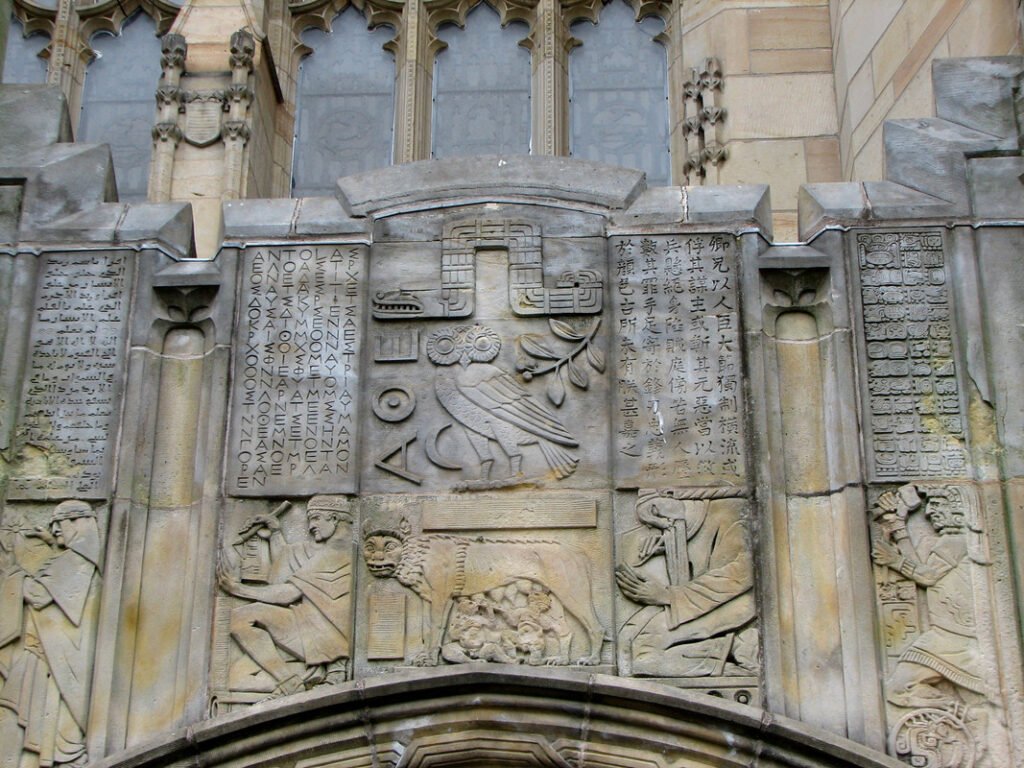
Above the main entrance of Yale University’s Sterling Memorial Library, eight stone carvings represent eight major civilizations of human history. Among them is a tribute to ancient Chinese civilization—an excerpt from the Yan Family Temple Stele by the renowned Tang Dynasty calligrapher and statesman Yan Zhenqing (709–785).
This stele, created in 780 AD, honors Yan Zhenqing’s father, Yan Weizhen. It recounts the family’s contributions to governance, scholarship, and public service across generations. Today, the original stele is preserved at the Forest of Steles Museum in Xi’an. The passage chosen for Yale’s library is carved into stone above its grand doorway and represents a pinnacle of Chinese regular script.
The inscription reads:
“Brother, as a minister of great integrity, single-handedly controlled the chaotic situation, either capturing their strategists or beheading the main culprits. When rescue was impossible, he was trapped in the enemy’s court, oblivious to his surroundings. He enumerated their crimes, placed his hands and feet on the sharp sword, and his loyalty and righteousness were evident in his expression. This is unprecedented in history, and I highly commend him.”
These lines (from the reverse side of the original stele) are from Emperor Suzong of Tang, responding to Yan Zhenqing’s petition of thanks for honoring his deceased cousin, Yan Gaoqing. The story alludes to a tragic and heroic episode from the An-Shi Rebellion (755–763), where Yan Gaoqing met a martyr’s end rather than submit to rebels—a moment that left a deep impression on the Tang court and on Yan Zhenqing’s legacy.
American sculptor Rene P. Chambellan carved the Yale inscription, basing his work faithfully on rubbings of the original stele. His careful reproduction preserves the historic authenticity and spirit of Yan Zhenqing’s calligraphy. Remarkably, this is the only known case of a Western artist adapting Yan’s work in a major public space, reflecting both cross-cultural respect and artistic dedication.
The inclusion of this Chinese inscription owes much to Professor Kanichi Asakawa (1873–1948), a Japanese historian and the first curator of Yale’s East Asian Library. Asakawa was a central figure in building Yale’s East Asian collection and a key advocate for incorporating Chinese civilization into the library’s symbolic architecture.
In 1931, when Yale’s design team sought to feature Asian contributions among the eight stone panels, Asakawa did not choose a Japanese text, despite being Japanese himself. Instead, he recommended the Yan Family Temple Stele, seeing it as an exemplary representation of Chinese cultural values. His decision reflected his deep respect for Chinese civilization and for Yan Zhenqing in particular—both as a master of calligraphy and as a symbol of Confucian loyalty and righteousness.
Yan Zhenqing’s influence extended far beyond China. Since his works were introduced to Japan during the Tang Dynasty, his bold calligraphy and unyielding character have inspired generations of Japanese calligraphers. From the great monk-scholar Kukai, who helped introduce Tang-style calligraphy to Japan, to the 2019 Tokyo National Museum exhibition Yan Zhenqing: A Master Beyond Wang Xizhi, Yan’s legacy has remained a touchstone of artistic and moral excellence.
Asakawa’s choice was also shaped by his appreciation for the emotional weight of Yan Zhenqing’s Eulogy for My Nephew, written in memory of Yan Gaoqing and his son after their martyrdom. The inscription now etched into Yale’s stone façade thus honors not just Chinese calligraphy, but the enduring East Asian ideals of loyalty, moral clarity, and intellectual integrity.
It is also worth noting a small anachronism in the Yale carving. Though the inscription is from the Tang Dynasty, the figure representing Chinese civilization in the carving wears Qing Dynasty attire—a long robe and a queue (braided hair), which would not have been worn in 8th-century China. Given that the carving was made in 1931 during the Republic of China era, and historical Chinese imagery in the West was still heavily influenced by Qing-era representations, this discrepancy is understandable and not particularly significant.
In sum, the Yan Family Temple Stele excerpt at Yale is more than a decorative element—it’s a bridge across cultures, time periods, and moral values. It speaks to the legacy of a calligrapher-statesman whose integrity and artistry continue to resonate, and to the foresight of scholars like Asakawa who worked to ensure East Asian culture had a lasting place in the Western academic world.